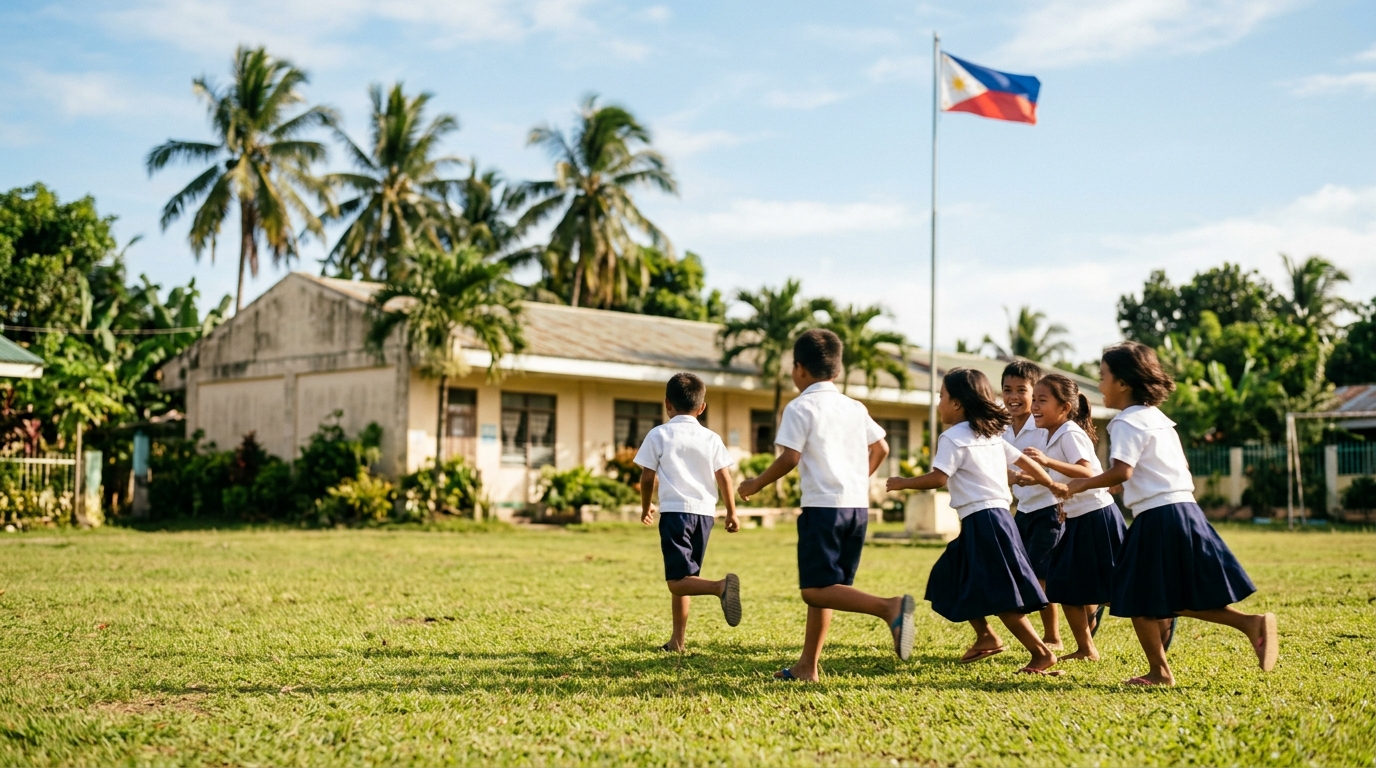
PAMPANGA — On March 18, 2026, inside the Kingsborough Convention Center, a document that had eluded 21 public schools for decades finally changed hands. Governor Lilia "Nanay" Pineda and Department of Environment and Natural Resources–Provincial Environment and Natural Resources Office Officer‑in‑Charge Roger Incarnacion personally turned over original certificates of title to school principals and heads, formally ending years of legal uncertainty for educational institutions that had been operating on land they could not prove they owned. For Pampanga's property sector, the ceremony was more than an administrative milestone. It was the removal of a legal cloud that had hung over school properties—and, by extension, the neighborhoods surrounding them—for generations.
The 21 titles represent the leading edge of a much larger problem. According to the Provincial Assessor's Office, DepEd–Schools Division Office Pampanga manages 535 school sites across the province. Of these, 59 remain entirely undocumented, 237 are titled or tax‑declared under local government units, 60 are titled under DepEd itself, 123 are privately owned, and 56 are titled under various national government agencies. "Dekada na kasing kani‑kanino pa nakatitulo ang mga lupa. Kaya naisip ko na dapat mailipat na ang mga ito sa pangalan ng DepEd, mga National Government Agencies, o ng LGU. Kung may mga pribadong pag‑aari, saka na lang natin sosolusyunan ang mga isyu roon," Governor Pineda said, capturing the fractured ownership landscape that the province has now begun to consolidate.
A Title That Unlocks National Funding—and Neighborhood Stability
The real estate significance of school land titling lies not in the transaction value of the properties—public school sites are not sold—but in what a clear title enables. DepEd officials present at the ceremony stressed that secured land titles are a prerequisite for accessing national funding for the construction of additional school buildings. Every classroom built on titled land expands the educational capacity of the barangay it serves, and in Pampanga's property market, school quality and classroom availability are increasingly decisive variables in residential location decisions.
The 21 newly titled school sites are spread across the province, from its urbanized core to its rural municipalities. Each title removes a layer of legal risk that has historically discouraged investment in surrounding properties. A barangay whose elementary school sits on undocumented land is a barangay where adjacent lot values are depressed by the ambient uncertainty of unresolved ownership. When that school receives an original certificate of title, the risk profile of the entire neighborhood shifts, however incrementally, toward stability.
The initiative, originally started by former Board Member Mylyn Pineda‑Cayabyab, is part of a broader provincial strategy to resolve the tangled documentation of public land. Governor Pineda emphasized that strengthened coordination with LGUs and the enactment of relevant local ordinances will help expedite the processing and transfer of titles to DepEd. The province is simultaneously tackling privately owned school sites through separate negotiations, acknowledging that the 123 schools on private land will require a different legal pathway than those on public land.
A National Push That Pampanga Leads
The March 18 turnover aligns with the national government's "Handog ng Pangulo: Luntiang Bukas" program, under which the DENR has committed to issuing 660 legal titles for public school sites across the country in 2026. Environment Secretary Juan Miguel Cuna framed the initiative in terms that connect directly to the property sector's long‑term calculus: "The most important thing we can give our children is a secure place to learn. When a school has a clear title, it is no longer at risk of being taken or disputed." The statement describes a principle that property economists have long recognized: titled land is investable land, and the institutions that occupy titled land anchor the communities around them.
Of the 44,178 school sites monitored nationwide as of March 6, 2026, the 21 titles issued in Pampanga represent a fraction—but a fraction that other provinces are now watching. The DENR's Land Management Bureau oversees the titling process, with regional and field offices conducting surveys and mapping to verify boundaries alongside school and community representatives. The findings are used to prepare the legal documents necessary for the issuance of special patents or presidential proclamations, and the process is designed to be inclusive, inviting school principals, barangay officials, and community members to participate in field validations.
For Pampanga's property market, the significance of the 21 titles extends beyond the school gates. Each newly titled school site becomes a permanent, documented fixture of the barangay—a public institution whose legal status is no longer in question, whose boundaries are no longer contested, and whose future is no longer contingent on the resolution of a decades‑old filing. Governor Pineda's strategy of separating privately owned school sites from those on public land—"saka na lang natin sosolusyunan ang mga isyu roon"—reflects a deliberate sequencing: resolve what can be resolved now, and build momentum for the harder cases. The 21 schools that received their titles on March 18 are the first beneficiaries of that logic, and the neighborhoods they anchor are the quiet beneficiaries of their newfound legal clarity.