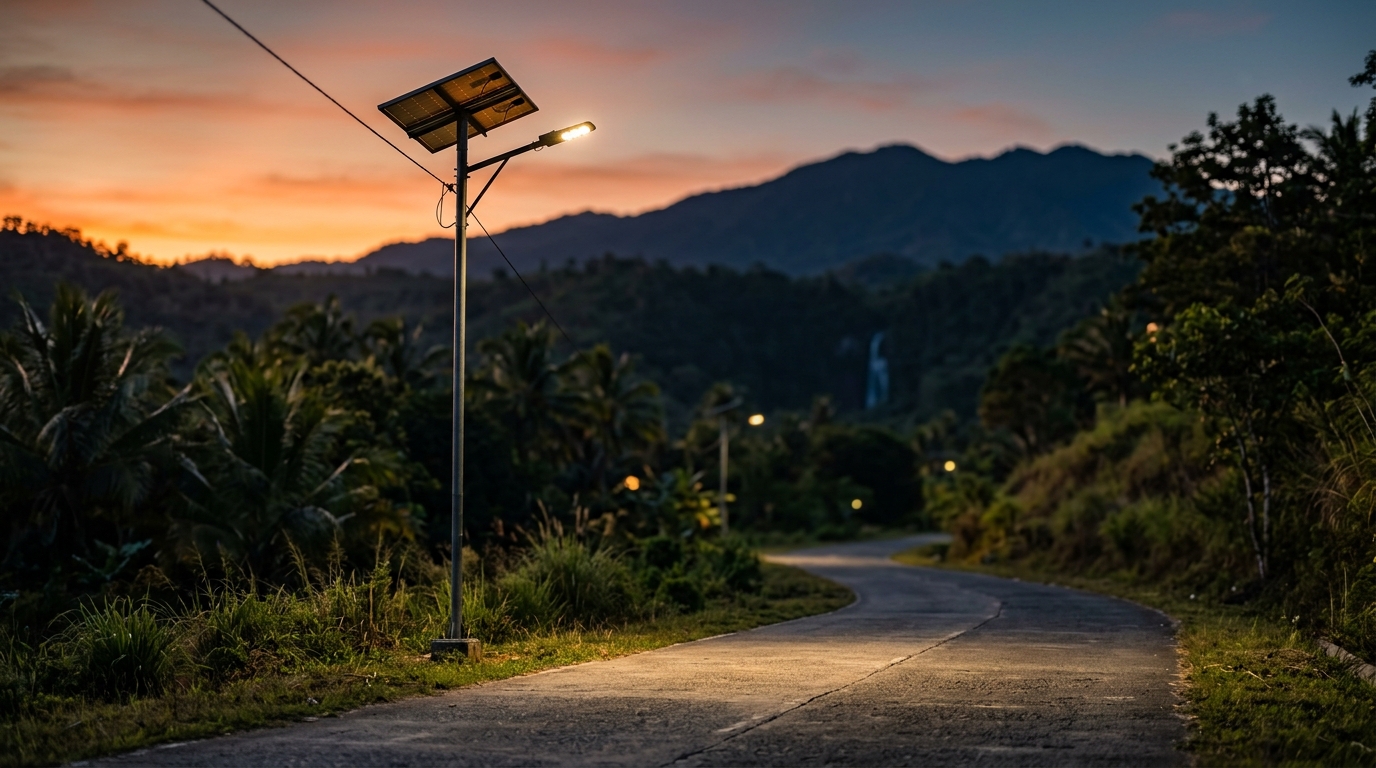
ANILAO, ILOILO — The town whose name is derived from the Hiligaynon word for lamp—ilaw—has finally received what its etymology has been promising for centuries. On May 11, 2026, Governor Arthur Defensor Jr. and Provincial Government Environment and Natural Resources Office chief Cesar Emmanuelle Buyco Jr. formally turned over ₱1 million worth of solar-powered streetlights to the municipality of Anilao, capping a project that will line the Barangay Poblacion‑Pansalan Road with autonomous, photovoltaic‑powered illumination. For a small northern Iloilo municipality that has only recently begun to register on the province's tourism radar, the lights are both a practical upgrade and a symbolic one: the town called "light" now generates its own.
The turnover ceremony, held under the Iloilo Provincial Government's Environmental Engineering Program on Solar Panels and Streetlights Installation, was part of a twin release that also delivered ₱1 million to neighboring Banate for a solar‑powered Municipal Recovery Facility. Governor Defensor and PGENRO chief Buyco handed the checks personally, framing the investment as a continuation of the province's push toward climate‑resilient development. "The initiative underscores Iloilo's commitment to cleaner energy solutions and environment‑friendly infrastructure that improve public services and the quality of life in local communities," the provincial government stated. For the tourism sector, the subtext is equally clear: a municipality whose attractions include waterfalls, caves, a mountain peak, and a fire festival rooted in 18th‑century resistance against Moro piracy now has the nighttime infrastructure to match its daytime offerings.
A Municipality That Tourism Has Only Begun to Discover
Anilao is not the Iloilo that dominates travel brochures. It sits in the province's Fourth District, a coastal municipality of modest size whose name carries a legend: when Moro raiders approached the shoreline in centuries past, villagers would shout "ilaw" and rush out carrying torches, creating a wall of moving light that convinced the raiders the settlement was larger and more fortified than it actually was. The place, according to local lore, was called Anilao from that moment forward—a name derived from light, born in defense, and preserved in identity.
The municipality today offers a portfolio of attractions that reward the traveler willing to venture beyond Iloilo City's heritage district. Darangkulan Waterfalls, located in Sitio Bagongbong approximately eight kilometers from the poblacion, cascades through a landscape of trees and boulders at the foot of Mt. Manyakiya, the highest peak in the municipality. Sta. Ana Waterfall, an enchanting cascade with a small cave, lies five kilometers from the poblacion. Both sites have drawn a growing number of domestic visitors, but their accessibility has historically been constrained by the condition of the roads leading to them—and, crucially, by the absence of reliable lighting that would allow visitors to depart at dusk without navigating unlit provincial roads.
The Banaag Festival, Anilao's signature cultural celebration, derives its name from a word meaning "blazingly bright." The festival commemorates the bravery of Anilao's ancestors through torch‑lit processions and fire dances that dramatize the victory of light over darkness. It has been credited with promoting Anilao as a tourist destination, drawing visitors who come for the spectacle and stay for the waterfalls, the mountain, and the quiet charm of a municipality that has not yet been reshaped by mass tourism. The solar streetlights now lining the Poblacion‑Pansalan Road extend the festival's central metaphor into permanent infrastructure: the town of Banaag is now, quite literally, lit.
A Northern Iloilo Tourism Circuit Gains Its Evening Infrastructure
The Anilao solar streetlight project does not stand alone. It forms part of a broader provincial strategy that has seen similar installations in Concepcion—where 248 solar streetlights now illuminate the poblacion and adjoining barangays—and Carles, the gateway to the increasingly popular Islas de Gigantes. These investments, distributed across multiple municipalities under the Environmental Engineering Program, function as the connective tissue of a northern Iloilo tourism circuit that links the scallop boats of Carles to the sandbars of Concepcion to the waterfalls of Anilao.
For the traveler, the practical benefit is immediate. A visitor who spends the afternoon hiking to Darangkulan Falls can now return along a road lit by solar‑powered lamps, eliminating the rush to beat sunset that has long constrained the itinerary of inland Iloilo tourism. A family attending the Banaag Festival can linger through the evening's torch‑lit performances without navigating dark provincial roads on the drive home. The streetlights convert hours that were previously unavailable—the hours between dusk and bedtime—into usable tourism time, expanding the economic footprint of every visitor who comes to Anilao.
The solar component, meanwhile, aligns with the province's broader renewable energy push. Iloilo City has urged all 180 barangays to adopt solar power systems under Resolution No. 2026‑0236, and the provincial government has partnered with the Department of Energy to deploy solar photovoltaic systems in public buildings. The Anilao streetlights, by generating their own power and operating independently of the grid, demonstrate that renewable energy infrastructure can be deployed rapidly in rural municipalities without waiting for grid extensions or large‑scale capital projects. For tourism planners, this replicability is the project's most valuable feature: what works in Anilao can work in any municipality whose attractions are currently dimmed by the absence of street‑level illumination.
A Name Finally Fulfilled
The word Anilao, depending on which etymological account one consults, means either "lighthouse" or derives from the cry of ilaw—light—that once summoned villagers to the shoreline with torches blazing. For centuries, that name was a memory rather than a description. The solar streetlights now installed along the Barangay Poblacion‑Pansalan Road do not rewrite that history, but they do fulfill it. The municipality named for light is now generating its own, sustainably and autonomously, and every traveler who drives that road after sunset benefits from the convergence of a centuries‑old name and a 21st‑century technology. For Iloilo's northern tourism circuit, the lights of Anilao are a small but significant addition—one that promises, like the Banaag Festival itself, to turn darkness into destination.