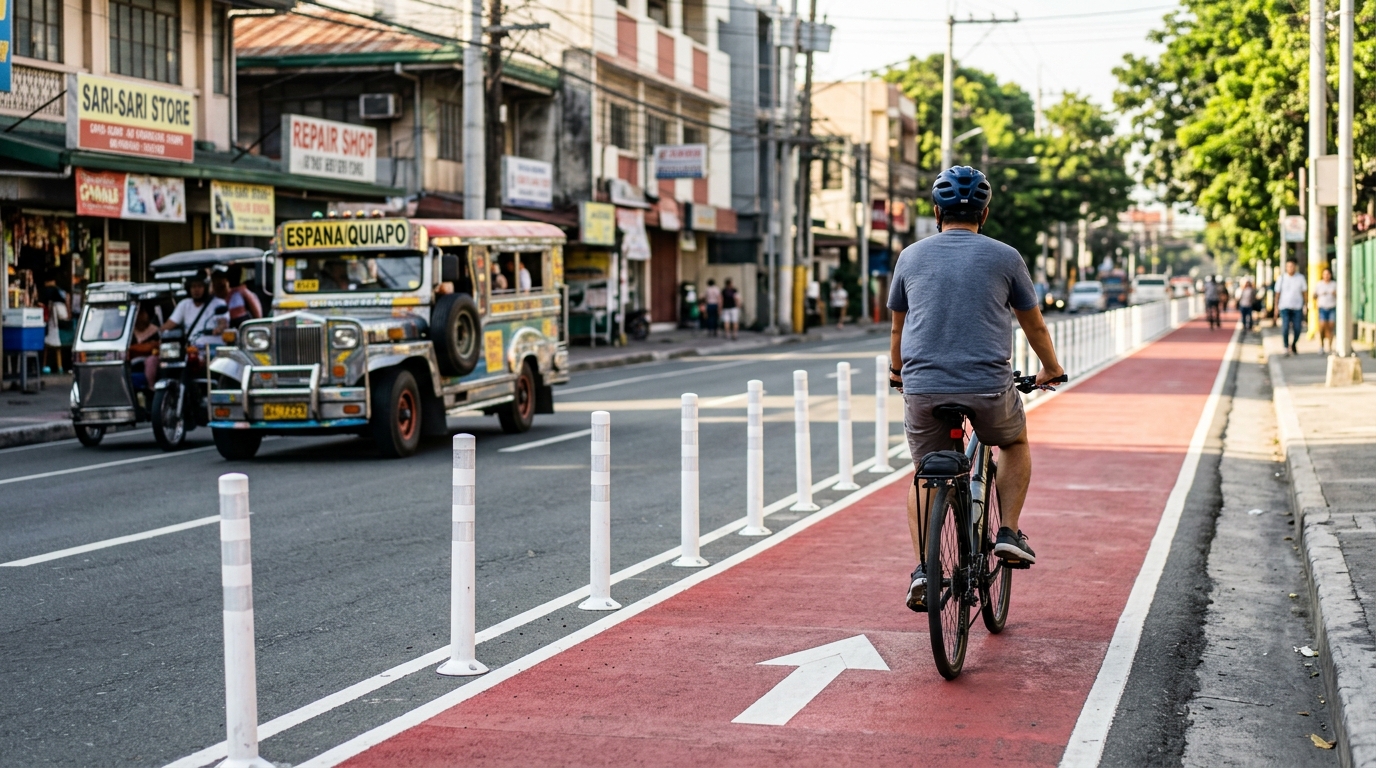
ANGELES CITY, PAMPANGA — On May 20, 2026, Department of Transportation Acting Secretary Giovanni "Banoy" Lopez pedaled through the streets of this bustling Pampanga city to inspect something that had not existed a year ago: 11.1 kilometers of Class 2 cycleways, marked by pavement lines and protected by flexible bollards, stretching along MacArthur Highway and the FilAm Friendship Highway. The ₱38-million project, funded under the 2023 General Appropriations Act and completed on February 16, 2026, represents the newest addition to the country's growing active transport network. For Angeles City, it also signals a deliberate pivot toward a tourism model that invites visitors to experience the city at handlebar level.
The bike lanes run along MacArthur Highway from San Jacinto Rotunda to J. Valdez Street, and along FilAm Friendship Highway from Poinsettia Avenue to Don Juico Avenue. These are not recreational trails tucked away in a park. They are functional urban corridors that connect residential neighborhoods to commercial districts, schools, and employment centers. For the tourist arriving in Angeles City, the lanes offer a ready-made route through the city's everyday life—past its restaurants, its heritage buildings, and the steady hum of a community that has embraced two wheels as a legitimate mode of transport. Lopez underscored the safety dimension: "Talagang habang nagbibisekleta sila hindi nila tinitingnan yung likod nila."
A City That Decided to Ride Through the Fuel Crisis
Pampanga 1st District Representative Carmelo "Pogi" Lazatin, who joined Lopez during the inspection, noted that the bike lanes serve a constituency broader than recreational cyclists. "Hindi lang po mga bikers ang gumagamit ng bike lanes, pati yung mga nagtatrabaho sa ibang lugar, lalo na nang tumaas ang gasolina natin, marami nang gumamit ng bike lanes," he said. The observation captures a reality that has reshaped transportation patterns across the country: elevated fuel prices have pushed workers and students onto bicycles, and the infrastructure is rising to meet them.
For tourism, this shift carries a secondary benefit. A city whose residents cycle to work is a city whose streets are less congested, whose air is cleaner, and whose public spaces are more navigable for visitors on foot or on rented bicycles. The Angeles City Traffic Development Office, under Mayor Carmelo "Jon" Lazatin II, reinforced this vision by clearing obstructed bike lanes in February 2026, removing vehicles and objects that blocked the designated corridors. The enforcement action signaled that the city intends to protect its cycling infrastructure, not merely install it. For the tourist renting a bike to explore the city, that enforcement translates into a safer, more predictable riding experience.
The National Picture and the Local Opportunity
The Angeles City expansion forms part of a broader national push. As of the first quarter of 2026, the DOTr has completed 1,100 kilometers of bike lanes nationwide, nearly 46 percent of its 2,400-kilometer target by 2028. President Ferdinand R. Marcos Jr. has directed the construction of more bike lanes, walkways, and road space for public transport that are both inclusive and mobility-oriented. The national ambition creates a framework within which cities like Angeles can build local tourism products around active transport—bike tours, heritage cycling routes, and culinary crawls that connect the city's famous sisig joints and Kapampangan restaurants via safe, dedicated lanes.
Lopez confirmed that the DOTr is coordinating with the Land Transportation Office, the Department of Public Works and Highways, and the Angeles City government for the deployment of more traffic enforcers and the implementation of speed limits along bike lane corridors. The coordination signals that the bike lanes are not a finished product but an evolving system, one whose safety features will deepen as enforcement capacity grows. For tourism planners, this evolution matters: a bike lane network that becomes safer and more integrated over time is a network that can anchor an expanding portfolio of cycling-based visitor experiences.
Angeles City already draws tourists for its culinary scene, its proximity to Clark Freeport Zone, and its festivals. The 11-kilometer bike lane network adds a layer of infrastructure that makes the city navigable without a car—a variable that increasingly influences destination decisions among younger, environmentally conscious travelers. The lanes connect to a city that is actively clearing obstructions, coordinating enforcement, and signaling to residents and visitors alike that the bicycle belongs on its streets. For the visitor who arrives with a helmet and a sense of adventure, Angeles City now has 11 kilometers of reasons to stay and explore.