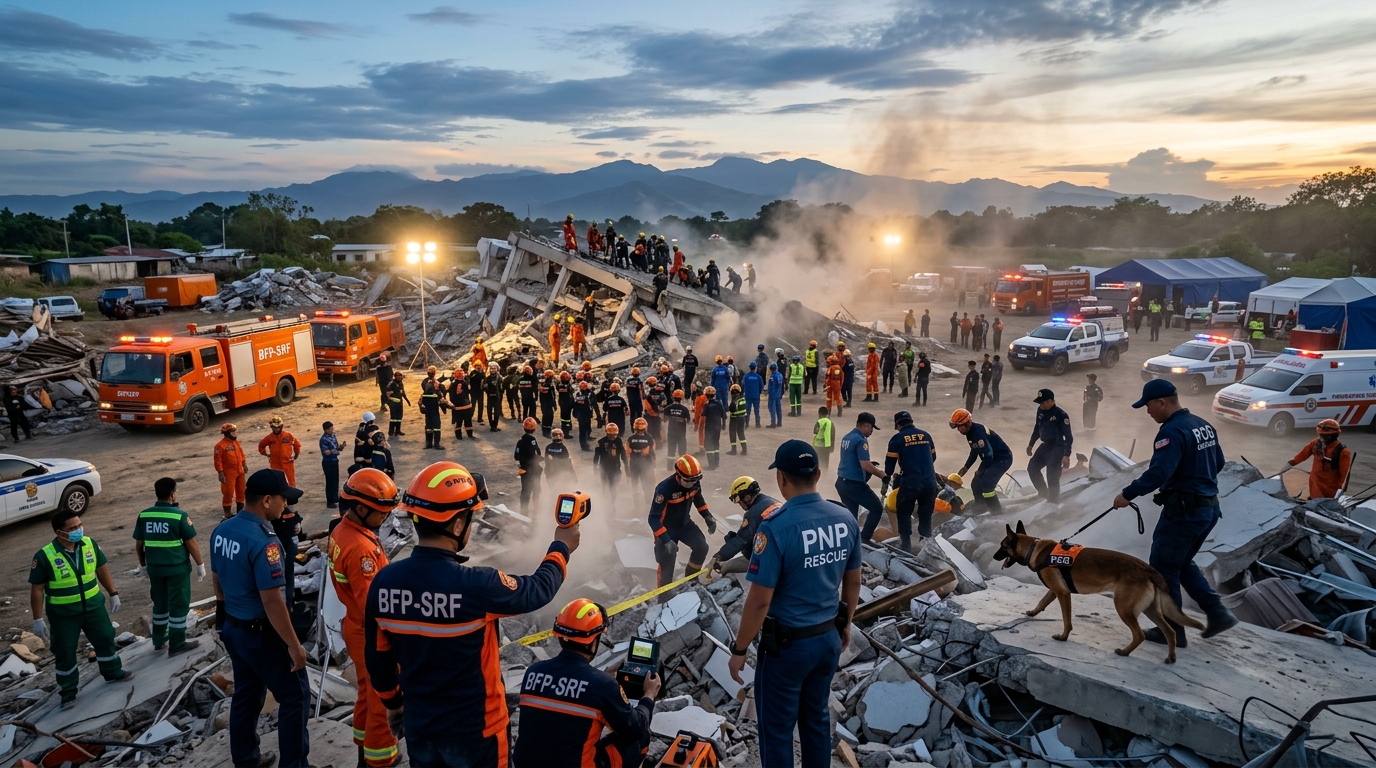
A force of 442 highly trained rescue personnel from across Central Luzon converged in Angeles City on May 24, 2026, demonstrating that the Philippines has reached a new level of disaster preparedness. The operation brought together 267 members of the Bureau of Fire Protection Special Rescue Force and Emergency Medical Service teams alongside 175 officers from the Philippine National Police, with additional K9 teams from the Philippine Coast Guard . The rapid mobilization from seven provinces — Pampanga, Aurora, Bulacan, Nueva Ecija, Tarlac, Zambales, and Bataan — showcases the region's highly efficient, modernized emergency protocols in action.
The Department of the Interior and Local Government captured the unwavering commitment of these responders: "Hanggang may mahagip, hanggang may maligtas, tuloy ang operasyon" (As long as there are people to rescue and lives to save, operations continue) . This unified response marks a significant milestone in the Philippines' 10-year strategic search and rescue roadmap, proving that years of investment in training, equipment, and inter-agency coordination have paid off.
The "One Response" Approach: Unified Command in Action
The operation exemplifies the "One Response" approach advocated by the DILG and the Office of Civil Defense, where multiple agencies train rigorously to operate under the same life-saving protocols . Rather than working in silos, BFP rescue specialists, PNP security personnel, PCG canine handlers, and EMS medical teams coordinated seamlessly from the moment of deployment . This unified command structure eliminates duplication of effort and ensures that every available asset is directed exactly where it is needed most.
The Philippine National Police chief, General Jose Melencio Nartatez Jr., ordered the immediate mobilization of police assets with a clear directive: "Every second matters in a crisis, and our duty is to act without delay—bringing every available asset to save lives, account for the missing, and support affected families on the ground" . Police Regional Office 3 personnel established an on-site first aid and welfare desk, providing immediate medical and psychosocial support while other teams focused on search and rescue.
Advanced Technology Marks a Leap Forward in Search and Rescue
The deployment of specialized technical rescue assets represents a significant leap forward in the Philippines' disaster response capabilities. Rescuers utilized thermal scanners and infrared technology to detect human body heat beneath unstable debris, while life detector equipment and cardiac monitors helped pinpoint exact locations of trapped individuals . Heavy-duty rescue trucks, ambulances, firetrucks, and canine units worked in tandem to cover ground that human rescuers alone could not efficiently search.
The PCG's K9 teams arrived at approximately 10:45 a.m. on May 24, underwent a comprehensive safety briefing, and began searching Sector 1 by 7:45 p.m.. Dogs Summit, Theo, and Travis gave positive indications in a specific area of the collapsed structure, leading engineering teams to conduct debris extraction operations that resulted in successful retrieval . The operation successfully rescued 26 individuals who were trapped under the infrastructure.
A Blueprint for Regional Disaster Cooperation Nationwide
The successful mobilization of resources from seven provinces demonstrates that Central Luzon's inter-provincial emergency response network can serve as a blueprint for other regions nationwide . The BFP, PNP, PCG, and local government units coordinated seamlessly under DILG direction, proving that when disaster strikes, help arrives swiftly and from multiple directions . Public Works Secretary Vince Dizon and MMDA General Manager Nicolas Torre III joined Angeles City Mayor Carmelo Lazatin II in monitoring rescue efforts, ensuring that national agencies remained fully integrated into the regional response.
For residents of Pampanga and nearby provinces, this operation proves that investments in disaster preparedness deliver real results when they matter most. As the DILG emphasized, the commitment remains unwavering: as long as there are people to rescue and lives to save, operations will continue. The 442 responders who answered the call have set a new benchmark for emergency response in the Philippines.