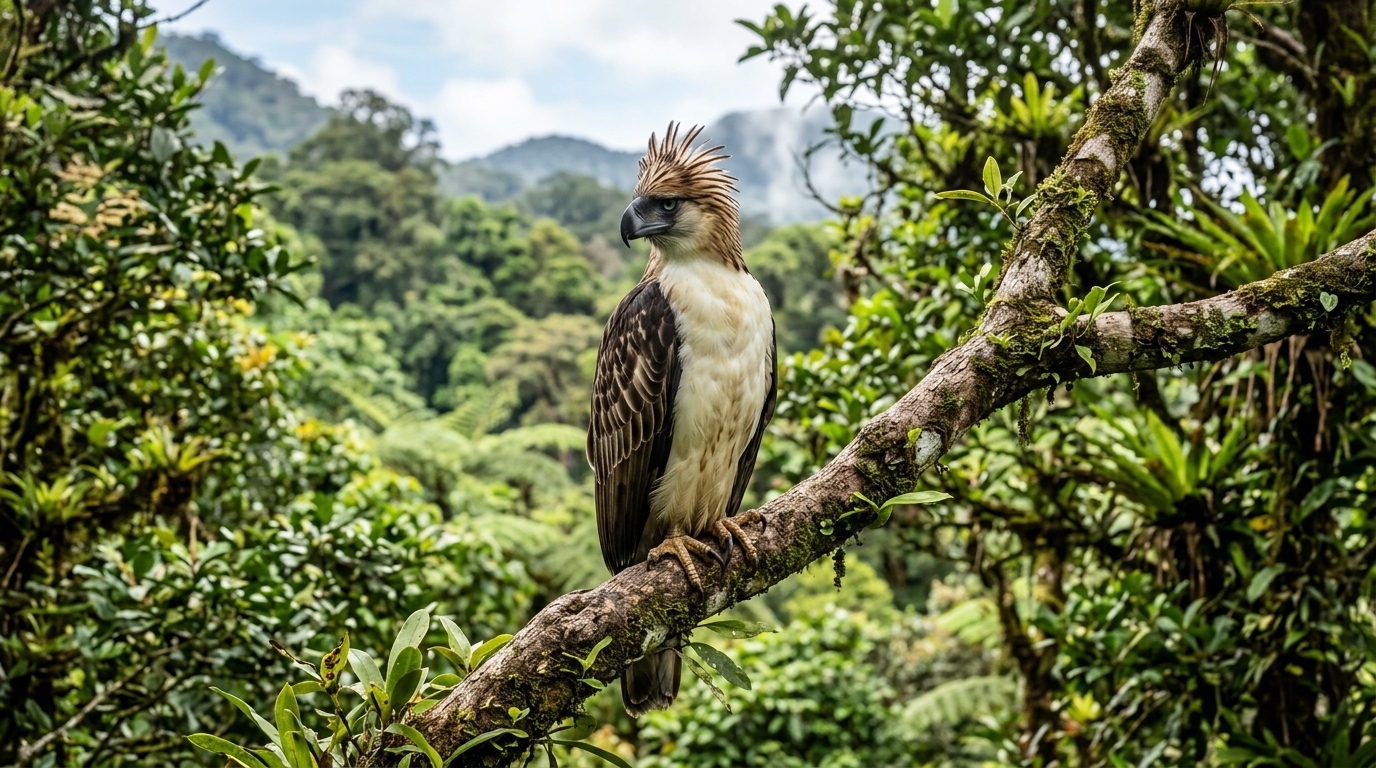
Davao City — One year after his historic translocation, Lakpue, a 23-year-old Philippine Eagle, is officially thriving in the forests of Leyte. Rescued as a fragile nestling in 2003 after being stolen from his nest in Mt. Busa, Sarangani, Lakpue spent years under the dedicated care of the Philippine Eagle Center in Davao City. On September 30, 2025, he was released into the forests of Barangay Kagbana in Burauen, Leyte, as part of a crucial conservation effort to repopulate the region’s eagle population, which had been devastated by Typhoon Yolanda in 2013.
Thriving in the Wild
Recent observations confirm that Lakpue has fully embraced his new environment, demonstrating behaviors characteristic of a healthy, wild Philippine Eagle. Biologists have tracked him navigating the dense forest landscape, where he is frequently seen hiding in thick foliage, patrolling riverbanks, and hunting from tree to tree. This successful adaptation is a major victory for conservationists, as it confirms that the translocation and release protocols—designed to give this critically endangered raptor a second chance at a wild life—are effectively working.
A Community-Led Protection Strategy
The survival of an eagle in a new territory relies heavily on the safety of his surroundings, which is why the Philippine Eagle Foundation has implemented a multi-layered monitoring and education program. Lakpue is tracked daily via satellite and radio transmitters, allowing experts to study his movement and hunting patterns while simultaneously reducing the risks of poaching or accidental trapping. Beyond technology, the success of this project is rooted in community involvement; the Municipality of Burauen has officially adopted the Philippine Eagle as its flagship species. Local government units, law enforcement agencies, and nearby communities have rallied together to implement gun bans and protection measures, ensuring that the local residents are active partners in keeping the forest safe for their new avian neighbor.
Building a Sustainable Future
The journey of Lakpue serves as a blueprint for future wildlife conservation efforts in the Philippines. By combining scientific monitoring with aggressive public education campaigns, the foundation aims to determine if these release methods can be scaled to help other eagles in different regions. Ongoing efforts are focused on securing long-term policy and funding support from the province of Leyte, aiming to turn this experimental release into a sustainable model for biodiversity. As Lakpue continues to thrive, he stands not just as a symbol of the Philippine Eagle’s resilience, but as a testament to what is possible when government, science, and local communities work in unison to protect our natural heritage.