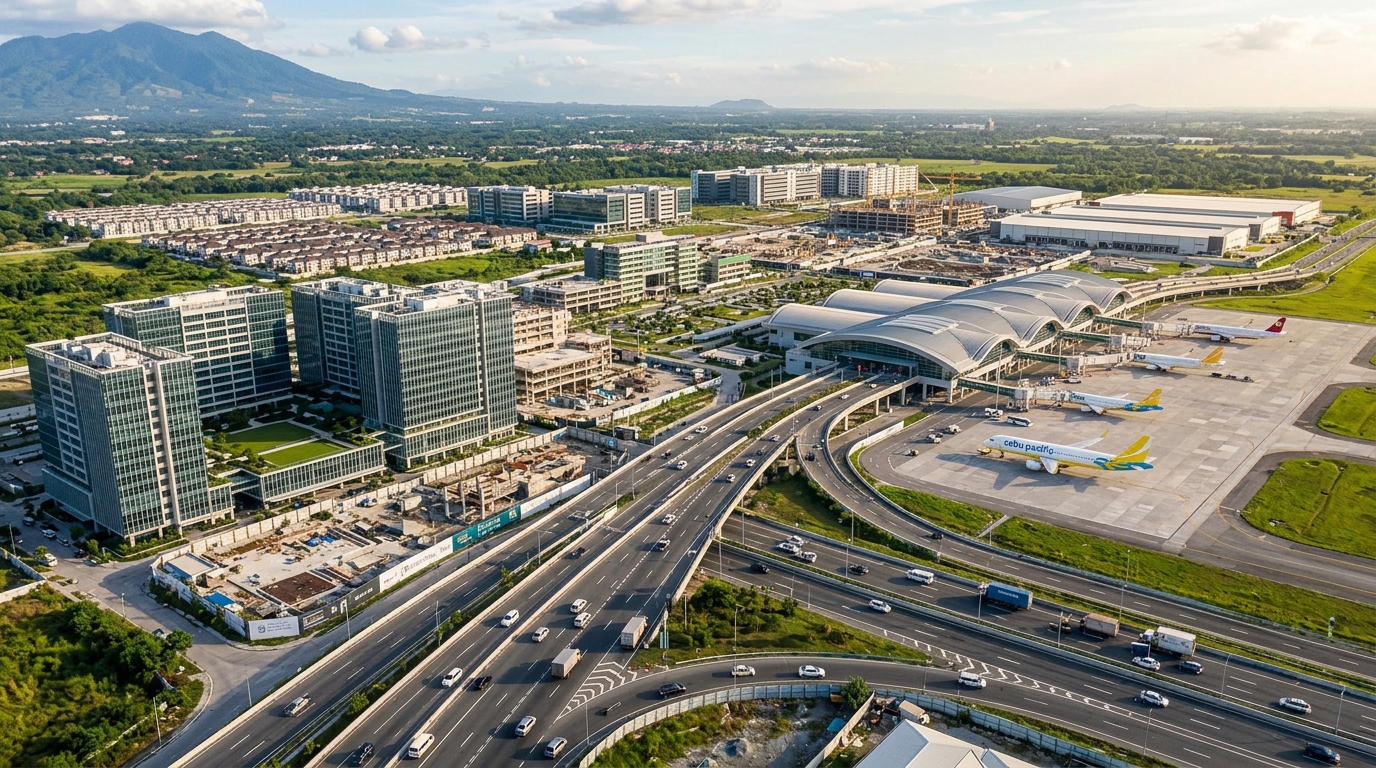
PAMPANGA — First, the tourists came for the sisig. Then the developers arrived for the land. Now, real estate analysts are officially calling it: Pampanga is the country’s next major investment destination, driven by genuine market demand rather than speculation .
Clark International Airport now handles direct international routes across Asia and the Middle East, with over 1,000 registered companies operating within the Freeport Zone . Travel time from Metro Manila is under 90 minutes, and major developers like Megaworld, Filinvest, and Hann have deepened their commitments across the province. With a growing population exceeding 2.5 million, this isn't hype—it's functional, measurable demand from employees, business visitors, and logistics activity.
Clark Airport’s International Expansion Opens the Floodgates
Cebu Pacific has been aggressively building up Clark as a regional hub, launching direct flights from Clark International Airport to Hanoi starting May 2, 2026 . The route, operating three times weekly, marks the fifth international destination served from Clark, joining Bangkok, Hong Kong, Tokyo, and Singapore . The Gokongwei-led carrier now stands as the largest airline by capacity at Clark, deploying a 180-seater Airbus A320 for the new Vietnam route .
Xander Lao, CEB President and Chief Commercial Officer, made the airline’s ambition clear: “Launching direct flights from Clark to Hanoi is an exciting milestone for Cebu Pacific as we continue to strengthen Clark as a hub” . This expansion comes as Clark International Airport is being positioned as an alternative gateway to the congested Ninoy Aquino International Airport, with direct international routes now covering key destinations across Asia and the Middle East .
Major Developers Pour Billions into Provincial Projects
The developer stampede into Pampanga shows no signs of slowing. Megaworld is investing approximately ₱10 billion to scale up its retail portfolio, with new malls rising in Pampanga, Bulacan, Cavite, and Bacolod . The Capital Mall, a four-level lifestyle destination within the 35.6-hectare Capital Town township in San Fernando, features a design that honors the heritage of the Pampanga Sugar Development Company (PASUDECO) . Construction is set to begin this year, adding to Megaworld’s growing footprint in the province.
SM Development Corp. (SMDC) has also entered the Pampanga market with Symphony Homes in Mabalacat, a horizontal residential project where units are priced between ₱2.9 million and ₱6.5 million . The project, scheduled for completion by 2029, features amenities including a swimming pool, open and co-working spaces, and a clubhouse . Colliers Research notes that nearly 70% of residential survey respondents prefer house-and-lot or lot-only units in North or South Luzon for their next investment, with Pampanga among the most attractive sites .
More Than Malls: Hotels, Logistics, and Industrial Growth
The investment story extends beyond residential and retail. Ayala Land Hospitality has partnered with Marriott to build a Moxy Hotel in the region, signaling confidence in Pampanga’s growing business and leisure travel market . Meanwhile, Stotsenberg Leisure Park & Hotel Corp., operating under the Casino Plus brand, was recently named to the Clark Development Corp.’s “Green List,” securing automatic renewal of its Authority to Operate as validation of its compliance with regulatory standards .
On the industrial front, Colliers Philippines reports that developers are building industrial parks across Central Luzon, with infrastructure projects in Pampanga improving accessibility and unlocking long-term property value . COEX Inc., a manufacturer of co-extruded bottles for agricultural inputs, renewed its 25-year lease with CDC after operating in Clark since 2001, signaling sustained investor confidence . Data centers are also emerging as a key growth segment, with more local and foreign operators setting up facilities in the country this year .
A Province Built for the Long Haul
What makes Pampanga different from previous real estate booms is the nature of its demand. Unlike speculative bubbles built on zero-sum investments, Pampanga’s growth is anchored by functional, measurable demand from employees working inside the Freeport Zone, business visitors flying into Clark International Airport, and logistics activity moving goods through Central Luzon’s infrastructure backbone .
The North-South Commuter Railway, once fully operational, will cut travel time from Clark to Metro Manila dramatically, integrating Pampanga even more tightly into the capital’s economic orbit . For Kapampangans, this means more jobs, higher property values, and a growing sense that their province is no longer just a weekend destination—it’s becoming the center of the Philippine economy north of Manila.