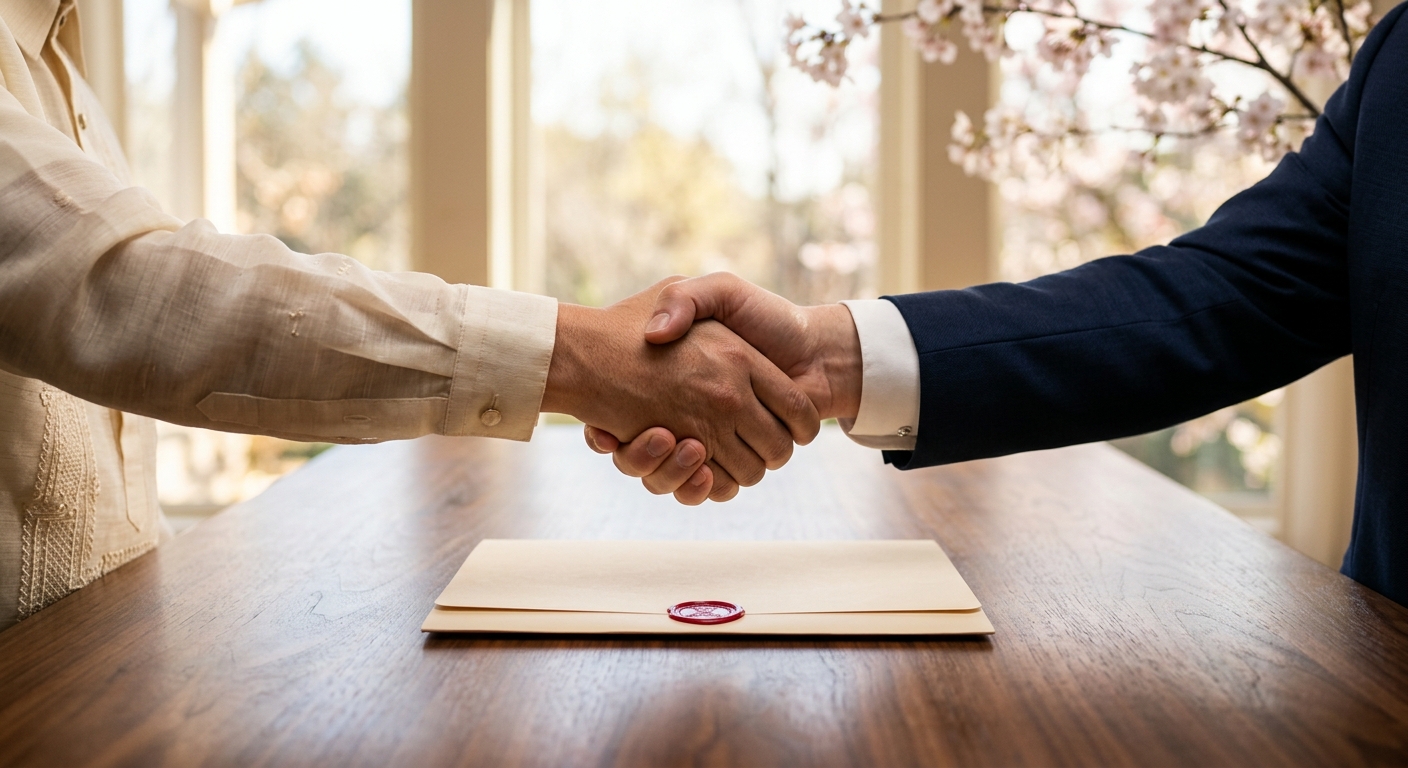
TOKYO, Japan — The Philippines and Japan signed a landmark intelligence-sharing agreement on May 29, 2026, in Tokyo, a pact that both governments said would strengthen coordinated responses to regional emergencies and directly improve the protection of the more than 300,000 overseas Filipino workers living and working in Japan.
A Security Umbrella for OFWs in a Tense Region
The General Security of Military Information Agreement (GSOMIA) establishes a formal framework for the secure exchange of classified defense and strategic intelligence between the two countries. Philippine Secretary of National Defense Gilberto Teodoro Jr. and Japanese Defense Minister Gen Nakatani signed the pact during the 12th Japan-Philippines Defense Ministerial Meeting.
Crucially for OFWs, the agreement covers non-traditional security threats that often disrupt civilian life: large-scale natural disasters, maritime incidents, and regional instability that could trigger emergency evacuations. By enabling faster intelligence sharing, Philippine authorities can issue more timely and precise advisories to Filipino communities in Japan, potentially saving lives and livelihoods.
The pact arrives as Japan expands its Specified Skilled Worker program to accept more foreign talent, with Filipinos comprising a rapidly growing segment. Philippine Ambassador to Japan Mylene Garcia-Albano previously emphasized that ensuring worker welfare and protection is a top priority, and this intelligence framework provides an added layer of institutional reassurance.
From Crisis Response to Job Security
Beyond emergency protection, the agreement indirectly stabilizes the employment landscape for OFWs. Japan’s demographic decline means its reliance on foreign labor will continue to deepen, and the Philippines has signaled its intent to become a premier source of skilled workers. A robust security partnership fosters trust between the two nations, smoothing the path for labor mobility agreements that benefit Filipino nurses, caregivers, factory workers, and engineers.
Japan and the Philippines already collaborate closely on disaster risk reduction—a critical consideration for a disaster-prone archipelago that hosts thousands of Filipino workers. The GSOMIA strengthens this cooperation, ensuring that both governments can share real-time hazard data and coordinate evacuation logistics when tsunamis, earthquakes, or typhoons threaten coastal communities where many OFWs reside.
This security architecture also provides a stabilizing counterweight during geopolitical tensions. If crises arise in the broader East Asia region, Filipino workers in Japan will be covered by a bilateral mechanism that prioritizes their safety alongside that of Japanese nationals, rather than relying on ad hoc arrangements that could falter under pressure.
A Growing Strategic Partnership with Human Dimensions
The intelligence pact is part of a broader deepening of Philippines-Japan ties that has accelerated throughout 2026. Earlier in May, the Philippine Coast Guard and Japan Coast Guard conducted joint exercises in the South China Sea, while economic cooperation has intensified through the Japan-Philippines Economic Partnership Agreement (JPEPA).
For OFW families, these strategic moves translate into something tangible: the knowledge that their loved ones work in a country that treats Philippine nationals as partners in security, not merely as guest laborers. Defense Secretary Teodoro noted after the signing that the agreement reflects “a shared commitment to a free and open Indo-Pacific” where the well-being of all citizens, including migrant workers, is a priority.
The Department of Migrant Workers welcomed the pact, stating that improved intelligence coordination would feed directly into its contingency planning for OFW populations across East Asia. With Japan now housing one of the largest Filipino communities outside the Middle East, the agreement marks a significant milestone in making worker protection a component of national security policy.