PHILIPPINES — Mitsubishi Motors Corporation is planning a multi-billion peso investment in the Philippines to support the production of hybrid electric vehicles, as it strengthens its position in Southeast Asia amid growing competition from Chinese EV makers.
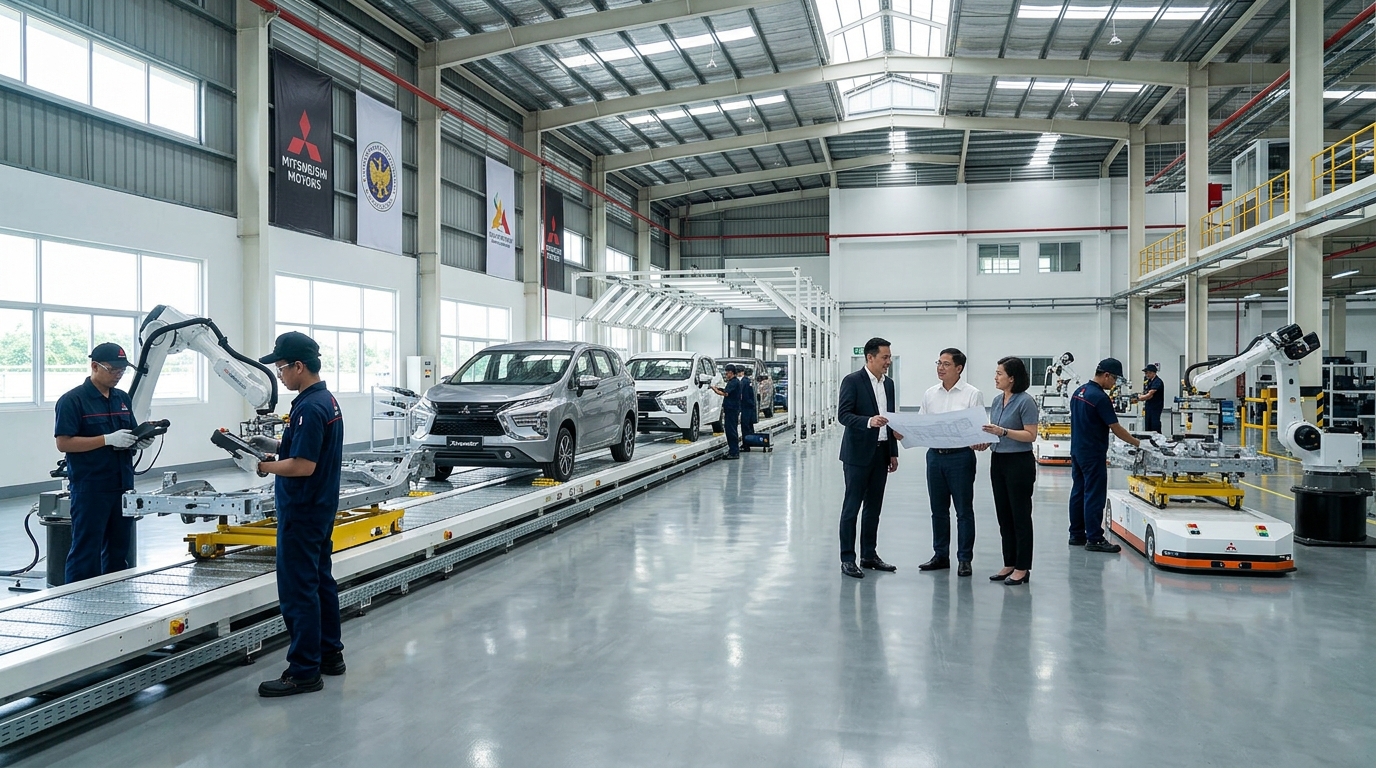
The initiative will upgrade its manufacturing facility in Santa Rosa, with hybrid production targeted toward the latter part of the decade. The expansion is expected to increase output capacity and position the Philippines as a potential export hub for the region, according to the Department of Finance.
Finance Secretary Frederick D. Go called the plan “a landmark investment that will redefine the future of our automotive industry,” adding: “The even more exciting possibility is that we could be an exporter of hybrid cars”.
A Pivot to Hybrids
This decision represents a change in strategy for Mitsubishi in the Philippines. In fact, as recently as August 2025, during an interview in Manila, the president and CEO of Mitsubishi, Takao Kato, explained that hybrid cars were “a good solution for the Philippines,” adding that there is “no hybrid component system supplier in the Philippines, and it is a little too early to introduce BEVs” due to a lack of charging infrastructure.
Now, less than a year later, those hurdles appear to be giving way to a formal production commitment. The turnaround underscores how quickly the automaker has moved to secure a foothold in the Philippines’ emerging electrification drive.
Kato, who met with President Ferdinand R. Marcos Jr. and Go at Malacañan Palace on April 6 to convey the plan, said the Philippines has “long been one of our most important markets, where we have engaged in production and sales for many years”.
The plan is contingent on approval of Mitsubishi’s application to join the government’s Electric Vehicle Incentives Strategy (EVIS), which offers fiscal and non-fiscal incentives for local EV production. The Department of Trade and Industry expects EVIS to generate ₱11.4 trillion in economic output and create about 680,000 jobs.
Beyond the new HEV model, Mitsubishi is also considering introducing plug-in hybrid vehicles (PHEVs) in the Philippines.
Strategic Counter to Chinese EV Advance
The investment comes as Japanese automakers face mounting pressure from Chinese rivals in Southeast Asia. Southeast Asia accounts for about 30 percent of Mitsubishi’s global sales, but the brand’s market share in Thailand and Indonesia has been under strain from an influx of lower-priced Chinese EVs and weakening local economies.
In the five major Southeast Asian countries, Mitsubishi’s market share stood at 7.4 percent last year, far behind Toyota’s 30 percent and roughly on par with Honda. Chinese players like BYD have been steadily gaining ground.
Kato said the company believes hybrids offer a competitive advantage in markets where charging infrastructure remains underdeveloped. “At present, our hybrid vehicles and new models are receiving very strong reviews. We can achieve ample growth in ASEAN,” he said.
Reducing Oil Dependence
The government sees the move as a chance to both lower the country’s heavy reliance on imported oil and create a higher-value manufacturing base.
By producing HEVs locally, the Philippines can reduce oil import dependence and cut urban emissions while aligning with the Electric Vehicle Industry Development Act (EVIDA), the DOF said. The government is also positioning the initiative as a way to transform the country from a largely assembly-based automotive industry into a manufacturing hub for advanced vehicles.
President Marcos Jr. welcomed the development in a social media post, saying: “Their continued investment reflects strong confidence in our economy. More jobs, less dependence on fuel, lower costs for drivers and more options for every Filipino”.
The Board of Investments is currently finalizing the EVIS program for endorsement to the Fiscal Incentives Review Board and presidential approval. Once the incentives are in place, Mitsubishi intends to proceed with production.
If realized, the Philippines will become only the second country after Thailand where Mitsubishi produces hybrid vehicles overseas, positioning the nation as a potential hub for next-generation automotive manufacturing in the region.