ILOILO CITY — On May 13, 2026, delegates from across Southeast Asia and Europe streamed into the Courtyard by Marriott Iloilo for an event no Philippine city had ever hosted. The first-ever ASEAN Regional Geographical Indications (GI) Forum and Exhibition, organized by the Intellectual Property Office of the Philippines (IPOPHL) and the European Union Intellectual Property Office (EUIPO), formally opened its doors, and the choice of venue was no accident. Western Visayas, home to the country's first two registered GIs—Guimaras Mangoes and Aklan Piña—was recognized as a model in promoting geographical indications, a designation that links a product's quality, reputation, and identity to its place of origin. The three-day forum, running through May 15 under the theme "SynerGI: Building Alliances for Sustainable GI Development," did more than fill a conference room. It made a case that the future of tourism in the region is inseparable from the stories embedded in its soil, its orchards, and its looms.
IPOPHL Director General Teodoro C. Pascua opened the forum by grounding the GI concept in language that resonated beyond the intellectual property specialists in the room. "A GI is, at its core, a story—of a place, a people, and a product that could only have come from them. This forum is where those stories meet," he said. "It's very meaningful that we are holding this gathering in Western Visayas because this region already understands something, if not many things, important about GIs. They help protect the identity, the reputation of the products that are uniquely tied to a place. But more than that, GIs help communities create opportunities from what they do."
The forum brought together representatives of ASEAN member states, partners from the European Union and international organizations, and relevant Philippine government agencies and local producers. Its explicit aim was to highlight how GIs can support rural development, cultural preservation, tourism development, and global competitiveness for local products. Deputy Director General Nathaniel S. Arevalo underscored the economic logic: "Through GIs, traditional products become premium market assets that strengthen regional identity, boost market competitiveness and enhance incomes."
The Exhibition That Told Stories in Three Dimensions
The opening day featured an exhibition and cultural showcase of GI products and traditions from the Philippines, ASEAN member states, and the European Union. Designed and mounted in collaboration with the Design Center of the Philippines, the exhibition was a curated walk through the sensory signatures of the region: jars of Guimaras mangoes, bolts of Aklan piña cloth, and a growing roster of Philippine GI products that now includes Alburquerque Asin Tibuok from Bohol and T'nalak Tau Sebu from South Cotabato.
The exhibition was not merely decorative. It functioned as a marketplace of ideas, where a Malaysian GI coffee cooperative could compare notes with a Guimaras mango growers' association, and where a European cheesemaker could explain to a Filipino local producer how a protected designation of origin transformed a farmstead product into a global brand. Gonzalo Bilbao, EUIPO project leader, brought the European experience into the conversation. "Based on the European Union experience, GI can help transform the community, the origin, and the reputation into an economic value," he said. "But the objective, I don't think, is to replicate the European model. Once again, the value of cooperation is to share experiences, practical lessons, and maybe to adapt them into the Philippine context."
Guimaras Mangoes: The GI That Tripled a Farmgate Price
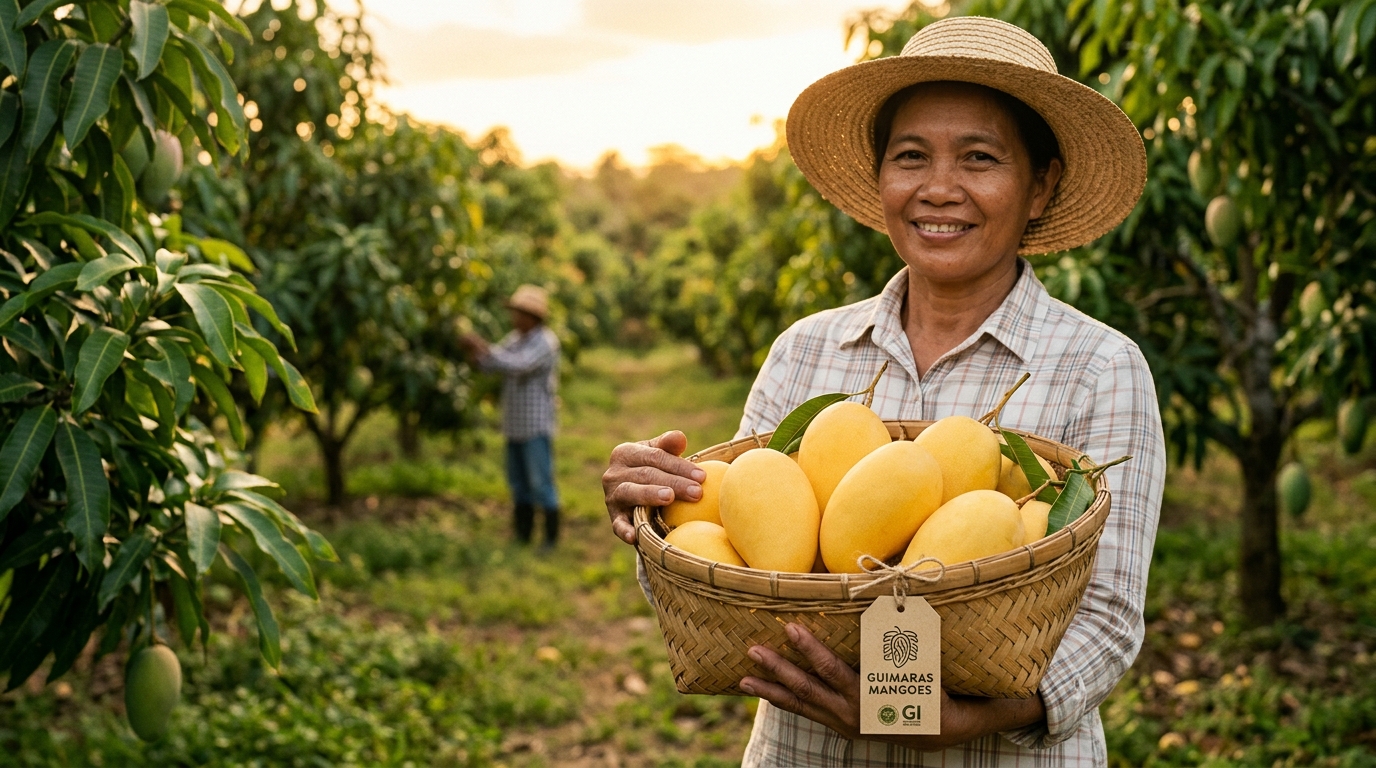
The most cited example throughout the opening day was Guimaras Mangoes, the first GI-certified Filipino product following its registration in 2023. The IPOPHL attributed the mangoes' unique sweetness to the island province's soil, topography, and climate—a combination that cannot be replicated elsewhere. Bureau of Trademarks Director Jesus Antonio Ros presented the hard numbers behind the designation: the farmgate price of Guimaras mangoes rose from less than PHP100 to as high as PHP300 during peak season. "It provides more income to the farmers, the producers of Guimaras mangoes," Ros said in a media conference during the forum's opening.
For the tourism sector, the Guimaras story is a replicable template. A product with a protected designation of origin becomes a draw in its own right. Tourists already travel to Guimaras to eat mangoes straight from the orchard, visit the processing facilities, and attend the annual Manggahan Festival. The GI registration amplifies that appeal, giving visitors a guarantee of authenticity—the assurance that the mango they bite into in Guimaras cannot be legally imitated by a grower in another province. The forum's program included a study visit to Guimaras on its final day, where delegates would observe firsthand how GI development can help promote local identity, tourism, and community-based enterprise.
Aklan Piña and the Revival of a Weaving Tradition
The region's second registered GI, Aklan Piña, tells a different but equally compelling story. The handloom weaving of piña fiber, long practiced in Aklan province, had been weakening as younger generations turned away from the labor-intensive craft. The GI registration in 2025, which complemented UNESCO's inclusion of Aklan piña handloom weaving in the Representative List of the Intangible Cultural Heritage of Humanity, reversed that decline. Ros noted that the GI encourages other producers in the value chain to participate in what had been a fading tradition. "Because of this highlight given to the piña, they are now returning to the traditional practices of making piña," he said.
For the traveler, this means a direct line between a cultural experience and a purchase. A tourist who visits Aklan can watch piña being woven, touch the finished fabric, and buy it knowing that the GI label guarantees its provenance. The forum sessions on May 14 delved deeper into GI development, enforcement, and support for producers, while regional stakeholders discussed market monitoring, consumer protection, and cross-border cooperation against GI misuse. The broader message was that a GI is only as strong as the system that protects it, and that the tourist who buys a GI-labeled product is participating in that system.
Why Iloilo, and Why Now?
Pascua acknowledged that the GI concept is relatively new in the Philippines, with regulations issued only in 2022. The country now has four registered GIs, with one pending application—the "ubi" of Bohol—and over 50 potential GIs identified across the country. The forum's placement in Iloilo City, at a hotel that sits within the Iloilo Business Park and a short walk from the Iloilo Convention Center, reinforced the city's growing status as a MICE destination. The Convention Center hosted over 150 events in 2025 and entered 2026 fully booked with a waitlist extending up to one year. The ASEAN GI Forum added to that momentum, drawing delegates whose spending on accommodation, dining, and transport injected direct revenue into the local economy.
For Western Visayas, the forum was both a recognition and a roadmap. The region now functions as the country's de facto GI laboratory, and every delegate who boards a boat to Guimaras on May 15 will experience the tourism product that a GI can anchor. The forum is not simply a three-day conference. It is the moment Iloilo became the address for a conversation that links the farm to the market, the loom to the luggage, and the place to the plate.