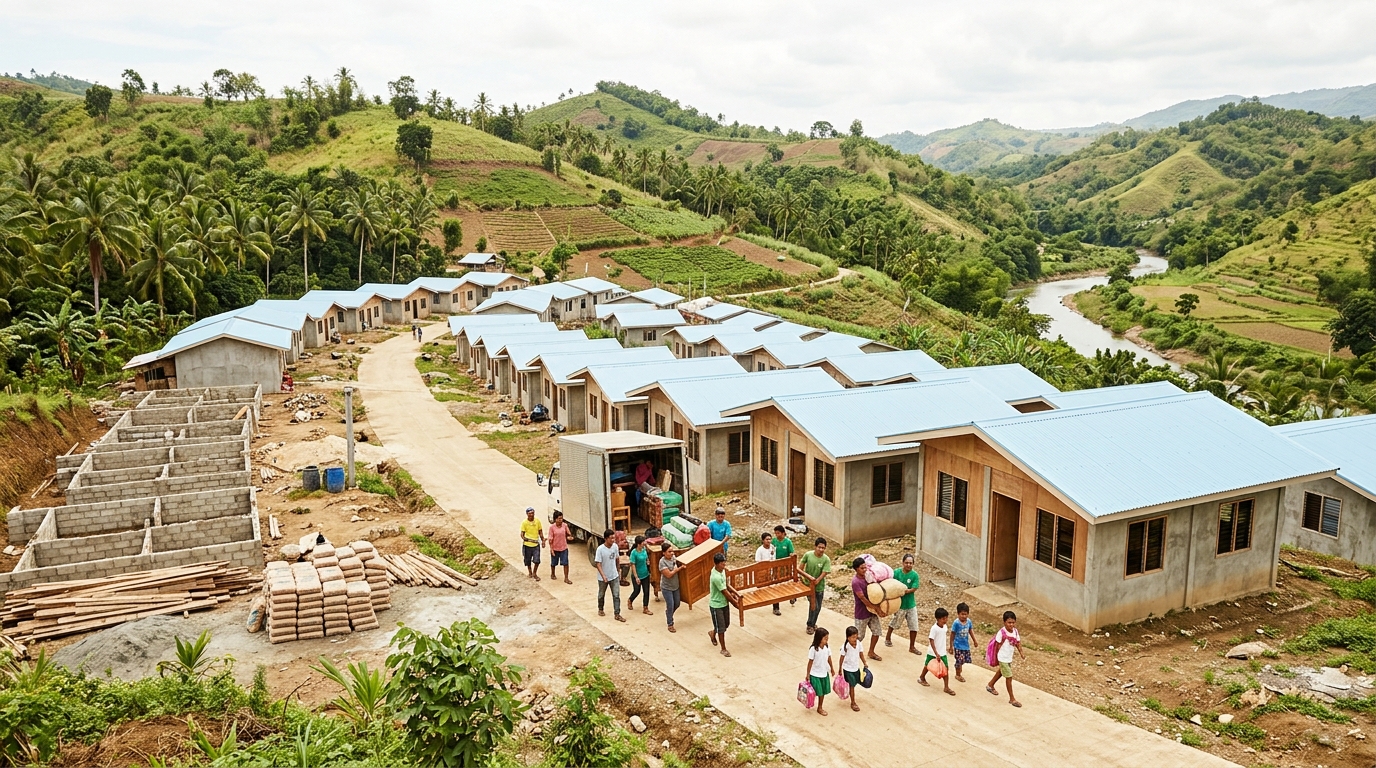
ILOILO CITY — On March 19, 2026, thirty families who had spent years living beneath a mountain crack in Barangay Nangka, Batad, walked into their new homes and closed the door on a lifetime of fear. Governor Arthur Defensor Jr. personally handed over the keys to the Purok Resilience Village, a P36‑million, 30‑unit socialized housing project that represents far more than a relocation exercise. For the province's property sector, already the strongest outside Metro Manila, the program signals that Iloilo is building climate‑adaptive infrastructure at the barangay level—and that kind of governance, over time, translates into land values that developers and homebuyers can trust.
Each 36‑square‑meter unit came move‑in ready with a kitchen, bathroom, and expandable bedroom, with provisions for a loft or second‑floor mezzanine. The 5,000‑square‑meter site, donated by the Municipality of Batad, was equipped not merely with basic utilities but with climate‑responsive infrastructure: rainwater harvesters, solar‑powered streetlights, underground power lines, and a dedicated water system. "The idea works. We can say it is a proof of concept for a socialized, small‑scale, barangay‑based, and climate‑response approach as well," Defensor said. "This is the first agrarian reform community with socialized housing."
A Model Engineered for Livelihood, Not Just Shelter
What distinguishes the Purok Resilience Program from conventional relocation projects is its refusal to separate housing from livelihood. The beneficiaries were not moved to a distant resettlement site disconnected from their farms and fishing grounds. The village was established within the same barangay where the recipients already lived and worked. "Sa probinsya, kung magkakaroon ka ng housing program, hindi natin dapat pwedeng ilayo yung mga beneficiaries natin sa lupa na kanilang sinasaka at sa kanilang mga banka," Defensor explained. "Dapat kung saan yung hanapbuhay nila at pamilya nila, dyan sila."
This proximity logic carries direct implications for the surrounding real estate market. When socialized housing is built within existing communities rather than on isolated greenfield sites, it reinforces the stability of the barangay rather than draining it of population. Families remain embedded in local economies, children stay enrolled in local schools, and the social fabric that sustains rural property demand remains intact. For property investors, a province that keeps its rural communities intact is a province where land values do not collapse in the towns that surround the urban core.
The Expansion Pipeline and What It Signals for Property Values
Batad is not an endpoint. The Purok Resilience Program is already slated for expansion into the municipalities of Oton, Concepcion, and Pototan—three towns that sit directly within Iloilo's fastest‑growing residential corridor. Oton, home to the 500‑hectare Savannah by Camella township, has absorbed substantial spillover demand from Iloilo City. Concepcion is the site of the proposed 142‑MW solar farm by MGen Renewable Energy Inc. and ACWA Power, a project that will inject construction jobs and municipal tax revenues into the local economy. Pototan, the province's agricultural hub, recently proposed a new Schedule of Market Values through the Provincial Assessor's Office.
The arrival of climate‑adaptive, barangay‑based socialized housing in these municipalities signals to the market that growth will be managed rather than chaotic. Developers who have been scouting land in Oton and Pototan can factor into their calculations a provincial government that is proactively relocating at‑risk families to safer ground rather than waiting for a disaster to force disorganized, emergency‑driven resettlement. The PRP has already received the Excellence in Disaster Preparedness recognition under the EXCEL Awards of the Department of the Interior and Local Government, an independent validation that the model works and will likely attract further national funding.
Where Barangay Housing Meets the National Blueprint
The Purok Resilience Program does not stand alone. In April 2026, Iloilo hosted the national launch of "Handog ng Pangulo: Luntiang Bukas," the Marcos administration's flagship initiative that integrates land distribution, climate‑resilient housing, environmental protection, and sustainable livelihood. Governor Defensor joined DENR Secretary Juan Miguel Cuna in awarding Certificates of Entitlement to Lot Allocation to PRP beneficiaries, alongside the distribution of 820 land patents across Western Visayas and Pag‑IBIG housing loans to families under the Kauswagan Residences project.
Colliers Philippines reported in its first‑quarter 2026 briefing that Iloilo's house‑and‑lot take‑up rate has reached 96 percent—the highest in the Visayas‑Mindanao region—while condominium take‑up stands at 89 percent. The province has outpaced Metro Cebu in total occupied office transactions, and Western Visayas was the country's fastest‑growing regional economy in 2025. Into this high‑demand environment, the Purok Resilience Program introduces a variable that property markets increasingly price in: a local government capable of executing small‑scale, climate‑adaptive housing that keeps families rooted in their communities. For the 30 families in Barangay Nangka, the proof is already under their feet.