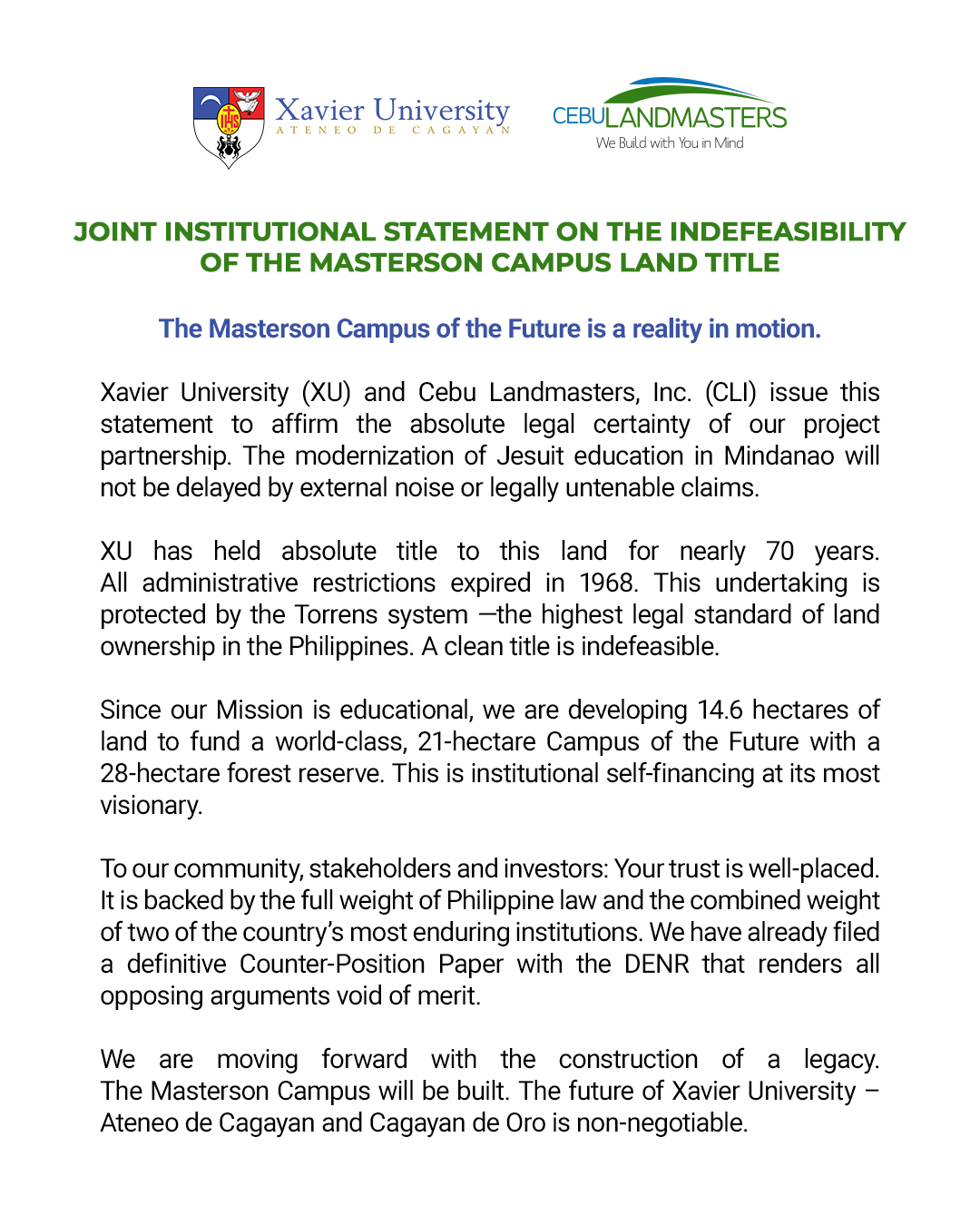
CAGAYAN DE ORO — There is a particular kind of confidence that does not shout. It does not issue threats or trade accusations. It simply states the facts and keeps building. On May 14, 2026, when the Department of Environment and Natural Resources ordered Xavier University‑Ateneo de Cagayan and Cebu Landmasters, Inc. to explain the commercial development of the 64‑hectare Manresa property within 15 days, the two institutions responded not with alarm but with a joint statement of unshakeable conviction. "The modernization of Jesuit education in Mindanao will not be delayed by external noise or legally untenable claims," they declared. "We are moving forward with the construction of a legacy. The Masterson Campus will be built."
The DENR probe, triggered by a petition from a local lawyer who alleged that the development violates Section 70 of the Public Land Act of 1936, is being treated by both XU and CLI as a procedural checkpoint rather than a crisis. The partners filed a counter‑position paper with the DENR seeking to dismiss arguments questioning the land title. "As good corporate citizens, we will answer any legal inquiries about the project," said Engineer Lennie Ong, project director of the XU Campus of the Future Planning and Development Office. "This is a significant development and a step closer toward enforcing the legal restrictions attached to the property," countered lawyer Ralph Metrillo, the petitioner. But the partners remain unmoved, describing their joint venture as "institutional self‑financing at its most visionary."
A Land Title That Has Stood for Nearly Seven Decades
At the heart of the legal question lies a land grant that predates many of the buildings that now line Cagayan de Oro's streets. The Manresa property originated from a 1958 sales patent that restricted its use to educational, charitable, or religious purposes. Metrillo argued that the joint venture with CLI—a publicly listed, for‑profit developer—directly contravenes those original conditions. "Unfortunately for Xavier and CLI, their lawyers' due diligence failed them," he said. "This is a very costly mistake."
XU and CLI see the matter differently. "XU has held absolute title to the land for nearly 70 years. All administrative restrictions expired in 1968," the joint statement read. The partners argued that the property is protected under the Torrens system, describing it as "the highest legal standard of land ownership in the Philippines." The distinction is not merely academic. A Torrens title is indefeasible, imprescriptible, and conclusive against the whole world. For the property investors and homeowners who have already bought into the vision of Manresa Town, that legal architecture is the foundation on which their trust rests.
A Vatican‑Approved Blueprint for Jesuit Education
The Manresa project is not a speculative venture hastily assembled. It is the product of a two‑year review by Jesuit leadership in the Philippines and Rome, culminating in the formal imprimatur of the Vatican in 2021. The approval covered the sale of portions of XU's properties, including the historic main campus in Divisoria, to fund the construction of the Masterson Campus of the Future—a 21‑hectare academic hub three times larger than the current downtown campus, designed to carry the university into its centennial in 2033.
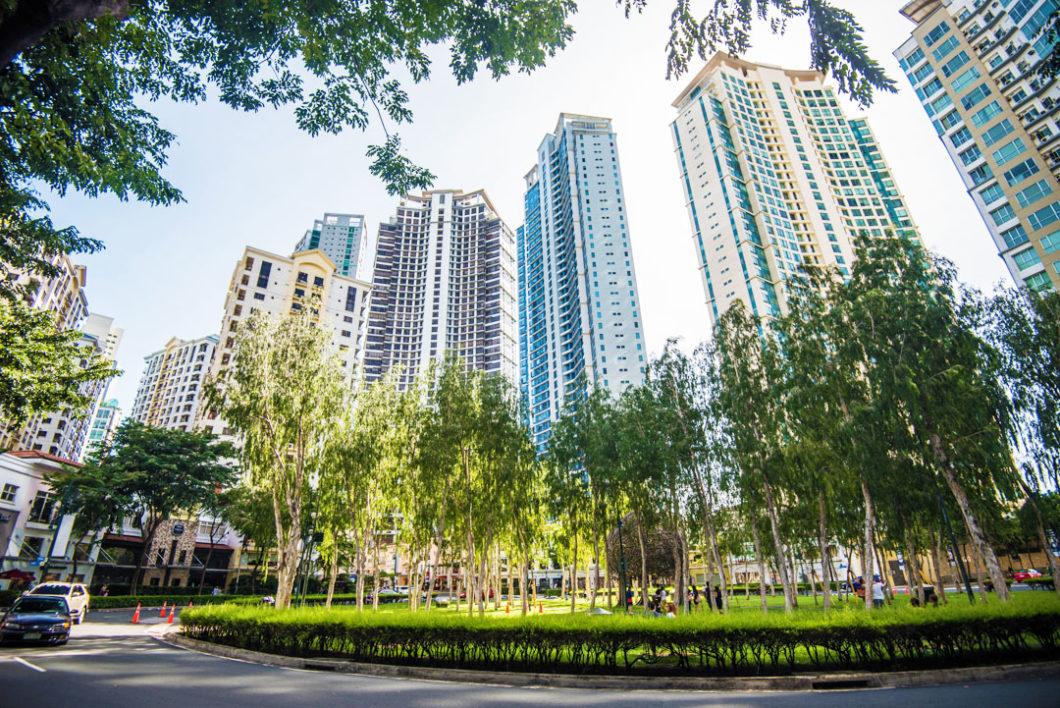
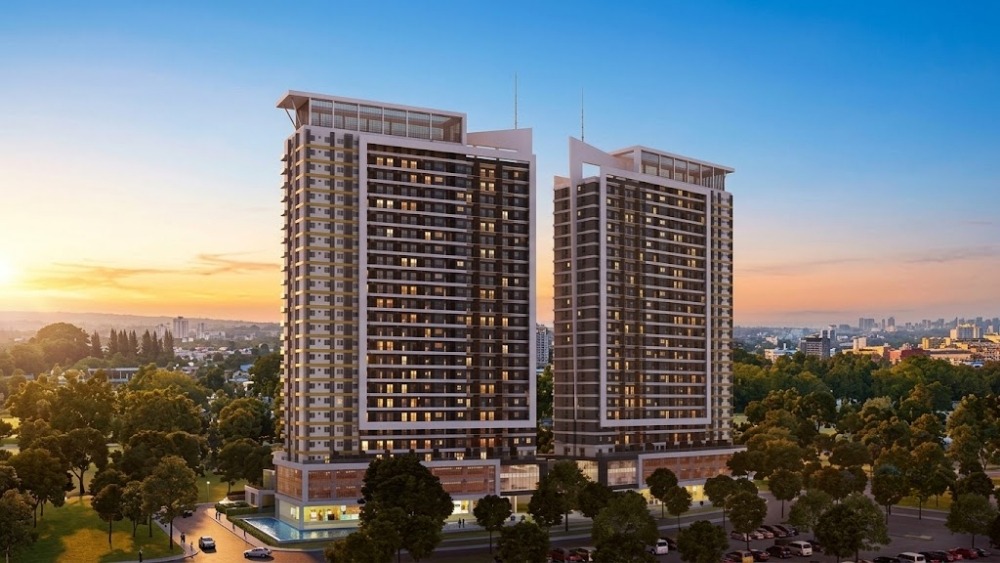
The commercial component, Manresa Town, covers 14.6 hectares and will feature residential condominiums, retail spaces, and offices. Its proceeds are not destined for shareholder dividends but for the construction of classrooms, laboratories, and libraries. A 28‑hectare forest reserve completes the master plan, ensuring that growth does not come at the expense of the environment. "Manresa Town is built to shape the future of Uptown CDO," said CLI Chairman and CEO Jose Soberano III. "By creating a sustainable, connected, and vibrant community for students, educators, and residents, it supports Cagayan de Oro City's growth and enhances the quality of life for everyone who lives and works here."
A Road Already Rising From the Ground
The most compelling rebuttal to claims that the project will be derailed is not found in legal documents but in the physical evidence of construction already underway. On January 23, 2026, XU and CLI held a concrete pouring ceremony for the ₱120‑million Manresa Access Road, a two‑kilometer, 10‑meter‑wide artery that will link Masterson Avenue to Balulang Road. Fully funded by CLI with land donations from both partners, the road is expected to be completed by the fourth quarter of 2027 and will cut travel times between Uptown and Downtown Cagayan de Oro while easing congestion across the city.
The road is not merely a piece of asphalt. It is the first tangible thread of a township designed around the "university town" model, where a premier academic institution drives high‑value real estate development. Wide roads, green spaces, bike lanes, and open areas are being engineered into the master plan, along with campus‑wide wireless connectivity and modern student amenities.
Underground, a quieter revolution is also underway. In April 2026, the installation of Cagayan de Oro's first 34.5‑kilovolt underground power line began at the Masterson Campus, a collaboration among CLI, XU, and CEPALCO that will serve the future university complex and its surrounding township. The project's first residential tower, One Manresa Place, generated ₱4 billion in sales within two days of its launch and now stands 99 percent sold, a signal of market confidence that no press release could manufacture.
Building Beyond the Noise
"XU's ownership of Manresa is not absolute. Section 70 is a mere statutory privilege which Xavier availed of back in 1956. It must therefore comply with all the conditions attached to this privilege," Metrillo argued. But the joint statement from XU and CLI was unequivocal in its response: "The modernization of Jesuit education in Mindanao will not be delayed by external noise or legally untenable claims." The language is deliberate. It asserts not merely legal innocence but institutional purpose. The project, in the partners' framing, is larger than any single regulatory inquiry—it is a commitment to the educational future of Northern Mindanao, anchored by a university that has produced generations of Kagay‑anon leaders.
For the city of Cagayan de Oro, the stakes are equally high. Mayor Klarex Uy hailed the Manresa Access Road groundbreaking as a milestone for urban connectivity, and the integrated development of Manresa Town and the Masterson Campus is widely seen as a paradigm shift for the city's growth trajectory. The project positions Uptown CDO as a model for future‑ready, integrated urban growth—a live‑work‑study‑play environment modeled after premier global university districts. That vision, now under a temporary cloud of regulatory scrutiny, is not collapsing. It is continuing, one road, one power line, and one legal filing at a time.