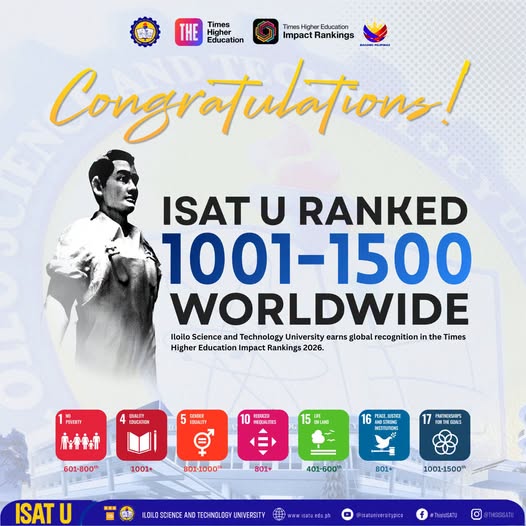
ILOILO CITY — Iloilo Science and Technology University (ISAT U) has been recognized in the 2026 Times Higher Education (THE) Sustainability Impact Ratings, securing a spot in the 1001–1500 bracket among 1,646 universities worldwide. The achievement places the institution on the global map for advancing the United Nations Sustainable Development Goals through education, research, and community outreach.
A Global Benchmark for Sustainability
The THE Impact Ratings evaluate universities based on how they address pressing global challenges through teaching, research, stewardship, and outreach. ISAT U’s inclusion reflects its steady integration of sustainability principles into its academic and institutional practices. The recognition highlights the university’s role in fostering inclusive growth and environmental responsibility in Western Visayas.
The university submitted evidence across several Sustainable Development Goals, demonstrating measurable contributions to poverty alleviation, gender equality, and reduced inequalities. Its performance across multiple indicators underscores a holistic approach to community development that extends well beyond the classroom. This broad engagement reveals a deeply embedded culture of service and accountability within the institution.
Leading in Life on Land
Among the strongest outcomes was ISAT U’s performance in SDG 15: Life on Land, where it ranked in the 401–600 band. This category assesses efforts related to biodiversity conservation, sustainable land use, and ecosystem protection, areas where the university has been particularly active. The placement signals a serious commitment to environmental stewardship that resonates with the province’s identity as a center of ecological richness.
The university’s initiatives under this goal include reforestation drives, campus greening projects, and research programs that support local farmers and fisherfolk. These efforts not only elevate ISAT U’s academic standing but also directly benefit the surrounding communities. The ranking validates the idea that a regional state university can become a global model for responsible land management.
Part of a Philippine Surge
ISAT U’s achievement comes as the Philippines posted a historic showing in the 2026 rankings, with a total of 160 higher education institutions making the global list. This represents the highest number of ranked universities from any country in this edition of the THE Impact Ratings. The surge signals a national awakening toward embedding the SDGs into higher education.
Against this backdrop, ISAT U’s placement carries added weight, positioning it among the country’s growing network of sustainability‑focused universities. The competition is steep, with institutions like Ateneo de Manila University leading the Philippine contingent, yet ISAT U held its ground by showcasing concrete, community‑centered impact. The recognition encourages other state universities to pursue similar global benchmarks.
Rooted in Community Service
Beyond metrics and rankings, ISAT U’s journey to global recognition is anchored in its long‑standing mission to serve the Ilonggo community. From scholarship programs targeting low‑income students to extension services that reach remote barangays, the university has built a reputation for accessibility and relevance. Its impact is felt not in abstract citations but in the improved lives of its beneficiaries.
The university’s performance in SDG 1: No Poverty, where it ranked 601–800 globally, exemplifies this commitment. Financial assistance programs, livelihood training, and partnerships with local government units have allowed ISAT U to address economic disparities head‑on. This grounding in everyday realities gives the global ranking a distinctly human dimension.
A Commitment to the SDGs
ISAT U’s participation in the THE Impact Ratings is not merely about prestige. It is part of a deliberate institutional strategy to align with the United Nations 2030 Agenda. The university has embedded the SDGs into its curriculum, research agenda, and administrative policies, ensuring that sustainability becomes a lived value rather than a slogan.
The recognition inspires a new generation of students and faculty to see their work as part of a global movement. It also challenges the university to deepen its impact in areas where scores were more modest, such as Quality Education and Partnerships for the Goals. ISAT U now stands as proof that a local university with limited resources can still make a global impact when driven by purpose and community.