
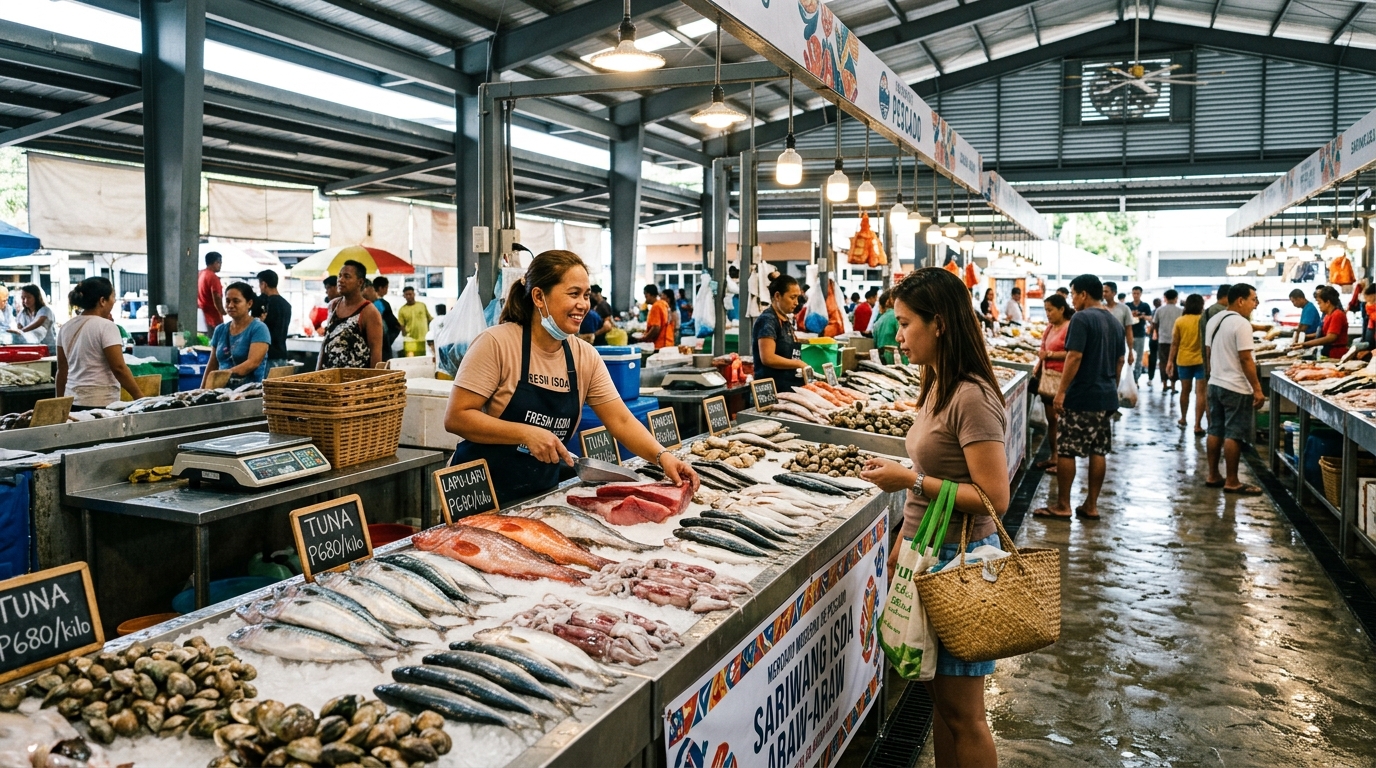
ILOILO CITY — The scene inside the newly redeveloped Iloilo Terminal Market earlier this year was one few city planners could have scripted. Tourist vans pulled up to the entrance, disgorging visitors who fanned out across the immaculate aisles. Within hours, several dried fish stalls had sold out completely—boxes of vacuum‑sealed danggit and pusit already stacked on the floor, waiting for pickup by buyers who had arrived not to provision a household but to experience a destination. Mayor Raisa Treñas, recounting the moment, was still visibly surprised. "You'd be surprised the stores ran out of dried fish because tourist vans were coming in. Boxes were already on the floor waiting to be picked up," she said. "We are now seeing our goal and our dream of helping our vendors."
That moment of empty shelves and full cash drawers was not a fluke. It was the first measurable result of a deliberate strategy that Iloilo City is now calling "market tourism"—the promotion of its redeveloped public markets not as mere trading posts but as full‑fledged tourist attractions. Treñas confirmed that City Hall, through the Local Economic Enterprise Office, is now deliberately promoting public markets as tourism assets in 2026, capitalizing on the strong demand for local food products and pasalubong items. "We are making sure to maintain our public markets because we are seeing that this is one of our tourist spot attractions that we can highlight, our market tourism," she said.
The strategy gained momentum with the reopening of the La Paz Public Market, capping a series of upgrades that included the Public‑Private Partnership redevelopments of the Iloilo Terminal Market and Iloilo Central Market. These are not cosmetic refreshes. Wide walkways, improved drainage, upgraded sanitation systems, organized vendor sections, and roof deck parking have transformed what were once purely functional spaces into destinations that visitors now seek out alongside the city's batchoy houses and heritage churches. The Iloilo Central and Terminal Markets were redeveloped into commerce hubs with dedicated public market areas reinforced by retail spaces, food halls, and banks—each component designed to sustain foot traffic and extend visitor dwell time.
Mandatory Training Before the First Sale
Before any vendor was allowed to return to the upgraded markets, they were required to complete training under the Uswag Negosyo Academy, the city's flagship capacity‑building program launched in 2022. The curriculum covers business registration, digitalization, food safety and handling, customer service, financial literacy, fair trade laws, and consumer rights. "Why redevelop our markets if we do not help our vendors first? We really equipped them with proper training," Treñas said. "If our market is upgraded, at least the learning of our vendors must also be upgraded."
The results are visible at stall level. Displays are now branded. The fish section features vacuum‑sealed products. Vendors who once stacked goods haphazardly now arrange them with the intentionality of retail professionals. "Our vendors have improved—even their displays look better. They now have branding. The fish section already has vacuum‑sealed products," Treñas said. The city conducted extensive training sessions under the Sige Asenso Program to ensure vendors were prepared ahead of reopening, a prerequisite that transformed the vendor‑customer interaction from transactional to experiential.
The impact on vendor income has been immediate. Joelle Iubel Janeo, the third‑generation owner of Rawit's Native Lechon Manok—a stall established in 1975—reported that business has been performing well since the improvements. "Nami ang amon kita kag sold out man ang amon native lechon manok everyday," Janeo said, noting that customers appreciate the improved layout and the ease of dining and purchasing in a more organized setting. Her experience mirrors that of the approximately 2,000 stalls now operating across the city's redeveloped markets, each benefiting from the surge in visitor traffic.
A National Benchmark Draws Pilgrims of a Different Kind
The transformation has not gone unnoticed. At least nine local government units and institutions nationwide have visited Iloilo to benchmark the project, including representatives from San Pablo, Laguna; General Santos City; Cabuyao, Laguna; Capiz; San Jose, Antique; and Tigbauan, Iloilo. Organizations such as the Baguio Business Club and the Department of the Interior and Local Government have also sent delegations. Among those who have visited are former Senate President Franklin M. Drilon and Presidential Communications Office Undersecretary Claire Castro, whose visits reflect a growing recognition that Iloilo City's public markets are no longer just local assets—they are becoming national reference points.
"I came here because I've heard so much about this," Drilon said, adding that the project may serve as a model for other LGUs. The redevelopment of the city's flagship markets was carried out through a public‑private partnership with SM Prime Holdings, while management remains with the Iloilo City Government. SM Prime President Jeffrey Lim described the partnership as one that safeguards pride through progress. "Ilonggos now have two modern, efficient and inclusive spaces that showcase their culinary heritage and entrepreneurial spirit," he said. Complementary upgrades to district markets in La Paz, Arevalo, and Jaro, funded by the city, are part of a broader effort to enhance commerce and community life across all barangays.
For visitors, the appeal is increasingly layered. The Terminal Market's architecture now integrates seamlessly with an adjacent SM Mall—a design choice that allows a tourist to move from the grit and vitality of a local palengke into a climate‑controlled retail environment through a single doorway. The Filipino Food Month 2026 launch, held at the Terminal Market in April, brought together the NCCA, UNESCO, the Department of Tourism, and the Department of Agriculture in a celebration that treated the market not as background but as protagonist. As more foreign and domestic tourists discover Iloilo City, these markets are playing a bigger role in showcasing its food culture and local enterprise—no longer a place to pass through, but a place to arrive.