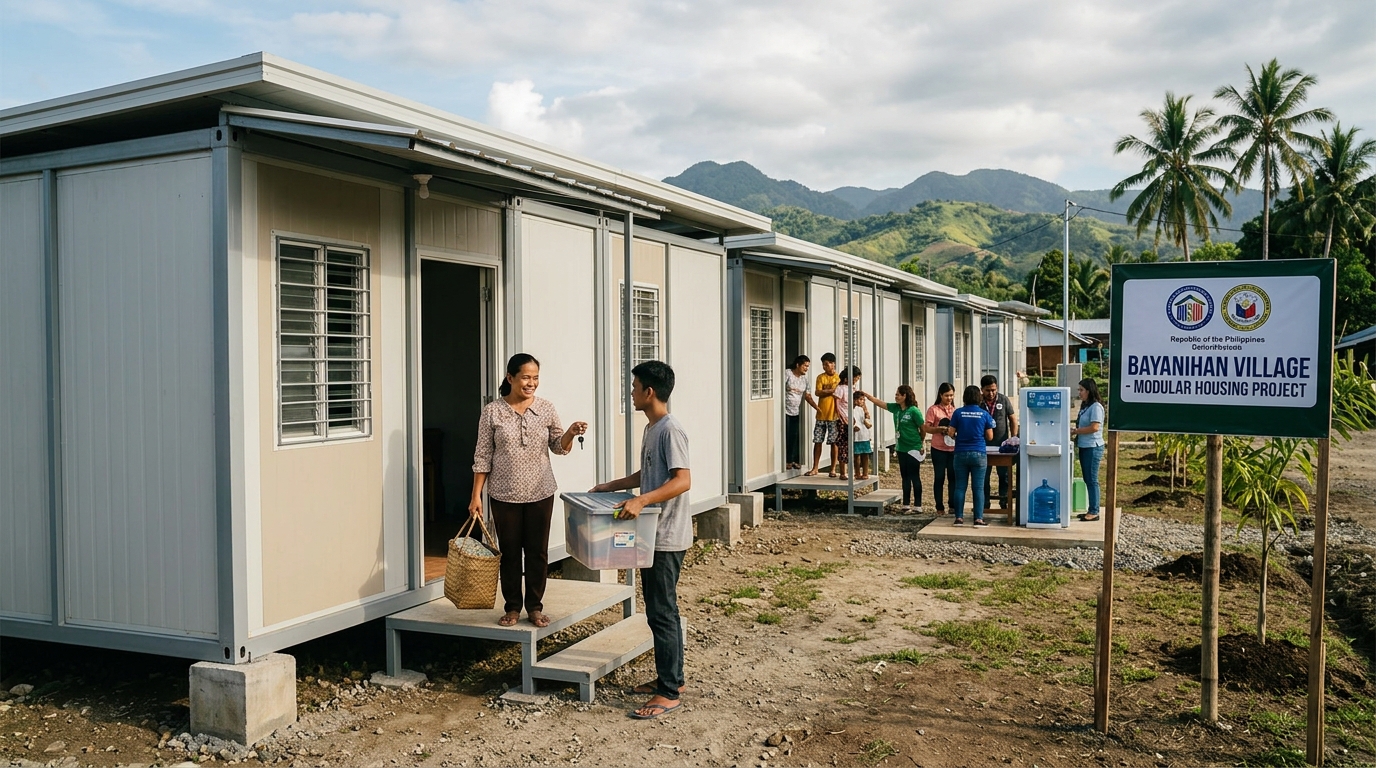
After months of enduring the elements in makeshift tents, families in Caraga, Davao Oriental, have officially transitioned into a more dignified chapter of recovery. On May 6, 2026, the Department of Human Settlements and Urban Development (DHSUD) Region 11 spearheaded the formal turnover of 25 new modular housing units to residents displaced by the powerful earthquakes of late 2025. This project, valued at approximately ₱4.3 million, represents a strategic shift in the Philippine government's disaster response, moving away from temporary "tent cities" toward sturdier, semi-permanent structures. For the families who lost everything in the October 2025 twin quakes, these modular homes offer a critical bridge between emergency survival and the long-term rebuilding of their permanent ancestral lands.
A Safer Sanctuary for Quake Survivors
The newly deployed modular units are designed specifically for emergency transition, offering a vastly improved living standard compared to traditional tarpaulin shelters. Each unit, costing roughly ₱175,000, is built to be weather-resilient and provides a private, secure space for families who have been living in evacuation centers for over half a year. During the turnover, beneficiaries like Predeswinda Magtana shared emotional accounts of their struggle in tents, where the scorching heat and unpredictable rains made daily life a constant battle. This 2026 rollout ensures that while permanent housing remains in the development pipeline, survivors can wait in a "safe and comfortable" environment that preserves their dignity and mental well-being.
The Logistics of the Bayanihan Village
This project is part of a broader "Bayanihan Village" strategy ordered by the national government to decentralize and speed up recovery in hard-to-reach municipal zones. In Caraga, the DHSUD worked closely with local leaders to identify stable ground that remains accessible to essential services like water and electricity. According to DHSUD-11 Director Norman Doral, these modular homes are not just structures but integrated units equipped with basic amenities that allow for a functional household life. This coordinated effort between the national and local government units (LGUs) has been crucial in bypassing the usual bureaucratic delays, ensuring that the first 25 families could "try their keys" and begin moving in just days after the units were finalized.
The Road to Permanent Resettlement
While the modular homes are a significant upgrade, officials have clarified that they serve as a temporary bridge until permanent resettlement sites are declared safe for habitation. The Office of Civil Defense (OCD) and the National Housing Authority (NHA) are currently conducting geotechnical assessments across Davao Oriental to identify zones that are no longer at risk for landslides or fault-line activity. As of May 2026, the provincial government, led by Governor Niño Sotero Uy, is actively seeking additional funding to convert these temporary clusters into permanent communities. For now, the successful turnover in Caraga serves as a proof-of-concept for 2026 disaster management, proving that modular technology is the future of humane, rapid-response housing in the Philippines.